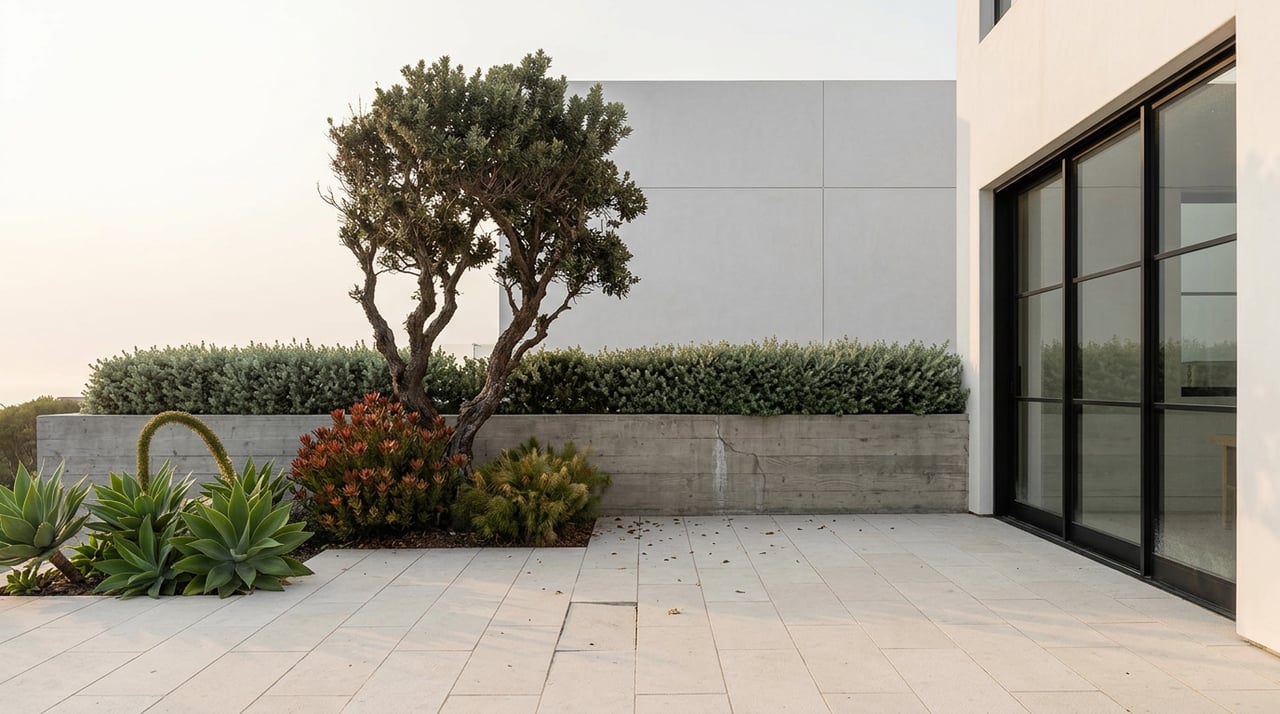
On Forward Street, in the same stretch of San Diego's coastal zone that includes Bird Rock, a homeowner set out to expand a modest 1,075-square-foot house into a 3,699-square-foot residence. The tripling of square footage didn't initially trigger a Coastal Development Permit requirement. Then the rains came. A wall crumbled mid-construction, and rebuilding it meant redoing more than half the original exterior walls, which crossed the threshold that requires a CDP under California Coastal Act regulations.
That story is the kind of thing a seller hears from a neighbor and files away as bad luck. It isn't. It's a preview of the question every bluff-top or coastal La Jolla owner needs to answer before listing, and it has nothing to do with square footage or asking price. The question is whether the house was built, or last substantially altered, before January 1, 1977.
The line that matters more than the setback
The California Coastal Commission interprets "existing" as structures lawfully constructed prior to January 1, 1977, the effective date of the Coastal Act. That date determines something concrete: whether a home retains a guaranteed right to armor itself against erosion. Post-1977 homes and substantially remodeled properties generally have no guaranteed right to a seawall. New construction typically comes with a permit condition that closes the door for good. New construction is typically conditioned to include a Waiver of Future Protection as part of the Coastal Development Permit, legally forfeiting the right to build or maintain a seawall.
This matters for a very specific reason: the kind of pre-listing renovation that raises a sale price is also the kind of renovation that can trip the "substantial remodel" wire. A kitchen refresh won't touch a home's coastal status. A full exterior rebuild, a major addition, or a rebuild after storm damage might.
| Original or lightly updated, pre-1977 | Substantially remodeled or built after Jan. 1, 1977 | |
|---|---|---|
| Seawall right under Section 30235 | Generally protected if erosion threatens the structure | Not guaranteed; owner must show imminent danger and no feasible alternative |
| Existing armoring | Can often be maintained under a Coastal Development Permit | New builds are typically conditioned with a forfeiture of future protection |
| Effect of a full remodel | Light work preserves the original status | Crossing the "substantial" threshold can erase it permanently |
For a $2.3 million to $2.5 million listing, that distinction is invisible on a spec sheet. For a buyer's attorney doing due diligence on a bluff-top property, it's the first question that gets asked.
What actually changed on July 1
San Diego's coastal bluff rules got harder on July 1, 2026, and the mechanics are worth understanding before assuming the new rule is the main story. Under San Diego Municipal Code Section 143.0143(f), new development has long been required to be set back at least 40 feet from the coastal bluff edge. Until June 30, 2026, when geotechnical requirements were added, including 75-year erosion projections and safety factors, total setbacks typically reached 53-55 feet from bluff edges.
As of July 1, 2026, the new setback guidance incorporates the California Coastal Commission's November 2024 Sea Level Rise Policy Guidance, unanimously adopted on November 13, 2024. The practical result is that total setbacks now reach 63 to 64 feet for most Pacific Beach, La Jolla, and Bird Rock properties, a 9 to 10 foot increase that changes project economics and design feasibility.
The reason the increase varies by block rather than applying uniformly is itself informative. Research using terrestrial laser scanning surveys along the San Diego coastline between La Jolla and Encinitas has documented linear rates of seacliff retreat ranging from 3.1 to 13.2 centimeters per year, with a weighted average of 8.0 cm/yr for the littoral cell. That regional average conceals critical neighborhood-level differences. A property near Calumet Avenue in Bird Rock, where erosion has been visibly narrowing the bluff for more than a year, faces a different calculation than a flatter lot set back from the edge.
The case sitting in front of La Jolla's permit committee right now
The clearest illustration of how this plays out isn't hypothetical. In April 2026, a Bird Rock property owner brought a bluffside remodel before the city's review body. A Bird Rock bluffside property owner navigated La Jolla's coastal permit requirements for a major expansion from 1,957 to 4,388 square feet, and the La Jolla Development Permit Review Committee requested additional information about fence materials, size confirmations, Floor Area Ratio calculations, and bluff setback plans during the April 2026 review.
That FAR question isn't a formality. The California Coastal Commission approved a 2021 San Diego Land Development Code update that put a maximum 0.6 FAR limit into the building code for La Jolla Shores, where there was not one previously. FAR limits in La Jolla typically range from 0.4 to 0.6 for single-family zones, so a 7,500-square-foot lot capped at 0.6 tops out at 4,500 square feet of structure. A remodel that pushes toward that ceiling, on a bluff lot that also needs the new 63 to 64 foot setback, is negotiating two limits at once, and either one can force a redesign after money has already been spent on plans.
The city's Development Permit Review Committee for La Jolla meets on a fixed public schedule, not on demand. The DPR meets on the 2nd and 3rd Tuesday of each month, requiring one to two weeks of advance notice to place a project on the agenda.
Miss that window and a listing timeline slips by a month, not a day.
What the Supreme Court just took off the table, and what it didn't
On April 23, 2026, the California Supreme Court issued a unanimous 7-0 decision reshaping the balance of power between the California Coastal Commission and local governments along the state's coastline. The Shear Development Co. v. California Coastal Commission decision establishes that the Commission cannot arbitrarily override county-approved building permits, reducing regulatory uncertainty that has affected coastal development for decades. Specifically, the ruling clarifies that if the City approves a project under the certified Local Coastal Program, the Commission cannot appeal based on subjective sensitive-resource designations not supported by official maps.
That is a real, procedural win for anyone with a City-approved project sitting in an appealable zone, which the California Coastal Commission defines broadly. A property between the first public road and the sea, within 300 feet of a beach or bluff top, on tidelands, or within 100 feet of a stream or wetland is typically appealable under Public Resources Code Section 30603. Most of bluff-top La Jolla qualifies.
What the ruling does not do is smaller than the headline suggests. The Supreme Court ruling doesn't change bluff physics or sea level rise, only the Commission's procedural authority to override local approvals. The geotechnical report, the setback math, and the FAR ceiling are unaffected. Typical timelines still stretch based on scope: minor interior or maintenance work can move in days to a few weeks, small discretionary projects run about three to six months, moderate bluff-adjacent projects with larger additions run six to twelve months, and major new construction subject to Coastal Commission appeal can take nine to twenty-four months or longer.
What one median price can't tell you
Anyone comparing La Jolla listing portals right now will notice the numbers don't agree with each other, and that disagreement is itself the story. As of August 2026, La Jolla homes were listed at a median price of $2.49 million, down about 1 percent from the prior month and from a year earlier, with a median 93 days on market in August 2026, unchanged from August 2025. Over the three months ending in May 2026, a separate read on closed sales showed a median sale price of $2.3 million, down 2.1 percent from the same period a year earlier, even as the average sale price climbed to $2.5 million, up 8.7 percent year over year, and homes took an average of 38 days to sell, compared with 25 days the year before. A third data pull, covering the 30 days ending in late May 2026, put the median closer to $2 million, $1,999,995, down 11.1 percent year over year, while nearly 45 percent of listings had a price drop and just under 21 percent sold above list, down more than 6 points from a year earlier.
Median down, average up, days on market rising in some reads and flat in others: that spread is not noise. It is what happens when a single zip code contains two markets that price on different logic. Village condos and inland Muirlands lots price on comparable sales. Bluff-top and first-row Bird Rock and La Jolla Shores estates increasingly price on defensibility, meaning whether a buyer's attorney can confirm the coastal rights survive the next remodel. Overpricing accounts for some of what sits unsold at the high end. An undisclosed or unresolved coastal status on a first-row property can stall a sale long after price has stopped being the objection.
Before you list or remodel a bluff-top home
- Pull the property's original construction date and any building permit history. The pre- or post-1977 distinction is the single fact that determines seawall rights.
- Ask whether any past renovation, or one you're planning now, would count as a substantial remodel under the certified Local Coastal Program rather than routine maintenance.
- Confirm whether an existing seawall or shoreline device carries a finaled, permanent Coastal Development Permit, or whether it was built under an emergency permit that never converted.
- Get a site-specific geotechnical bluff assessment early. Assessments by a licensed engineering geologist in San Diego coastal zones typically run approximately $8,000 to $40,000, depending on site complexity and the number of borings required.
- Model the setback increase into any addition plans before spending on architectural drawings. A property with a bluff setback under 40 feet can face a $50,000 to $200,000-plus cost event once the current fee and geotechnical requirements are applied.
- If the project sits in an appealable area, plan the calendar around the DPR's actual meeting cadence rather than a hoped-for timeline.
This is exactly where a project-managed approach earns its keep, not by pushing every renovation to the studs before listing, but by knowing which upgrades add value without disturbing a home's coastal standing, and which ones need a coastal land-use attorney in the room before the first permit application goes in.
FAQ
Does the new setback rule apply retroactively to homes already built closer than 63 to 64 feet from the bluff edge? The rule governs new development and additions going forward. An existing home built under prior standards isn't automatically out of compliance, but any addition, exterior alteration, or rebuild will be measured against the current setback.
If my home already has a seawall, am I protected no matter what? Not automatically. The seawall's own permit history matters as much as the house's. A seawall built under an expired emergency permit, or one attached to a home that later underwent a substantial remodel, may not carry the same protection the original structure had.
Does the April 2026 Supreme Court ruling mean the Coastal Commission is out of the picture for La Jolla remodels? No. It narrows one specific type of appeal, where the City has approved a project under its certified Local Coastal Program and the Commission tries to intervene using an unsupported sensitive-resource designation. Geotechnical review, setback calculations, and FAR limits still apply in full.
Selling or renovating a bluff-top or coastal La Jolla property involves more moving parts than a comparable inland listing, and the difference between a smooth close and a stalled one often comes down to due diligence most sellers never think to ask for. Fine Properties San Diego coordinates that groundwork alongside staging and marketing so a listing's price reflects what a buyer's attorney will actually find. Request a Complimentary Market Valuation to start with a clear picture of where your property stands.