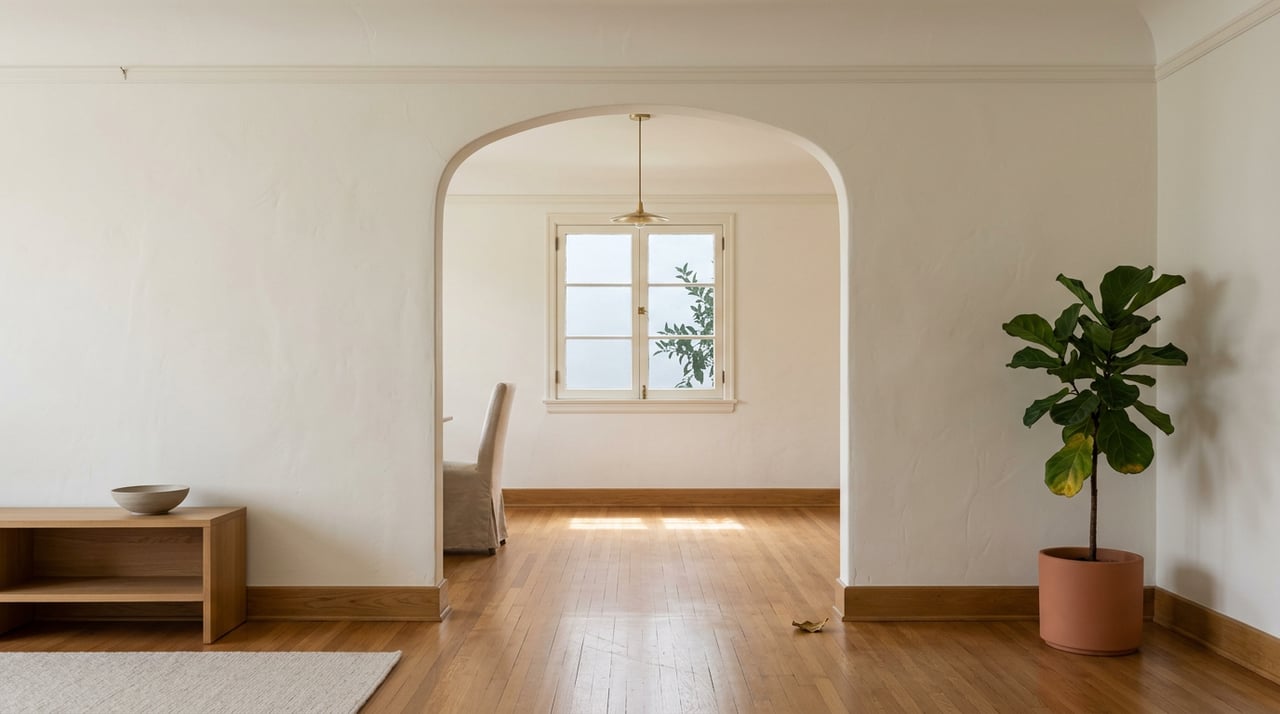
Two identical 1925 Spanish Colonial Revivals sit three blocks apart in North Mission Hills. Same square footage, same block character, same asking price within $40,000 of each other. One closes with a property tax bill in the low four figures. The other opens escrow with a bill three to five times larger, and the buyer only discovers the gap during the preliminary title review.
The variable is not the sale price. It is whether a Mills Act contract is already recorded against the property.
Most portal shoppers arrive at Mission Hills through the median. In March 2026 the San Diego Association of REALTORS put the year-to-date single-family median for ZIP 92103 at $1,621,250, and Redfin's neighborhood tracker read $1.54M for Mission Hills specifically, down 2.2% year over year. Those numbers describe what a home trades for. They do not describe what it costs to own, and in this neighborhood that second number is the one worth studying.
The two tax bills behind one asking price
The Mills Act is a state preservation program administered locally by the City of San Diego's Historical Resources Board. Owners of designated historic properties sign a contract agreeing to maintain the home to preservation standards, and in exchange the County Assessor reappraises the property using an income-based method rather than sales comparables. The assessed value usually drops. The tax rate does not, but the base it applies to shrinks, sometimes dramatically.
Statewide, the savings are typically cited in a 30% to 60% band. Local San Diego practitioners describe a range of roughly 40% to 60% on qualifying homes, and in Mission Hills specifically a $2M home under contract has been described as saving $10,000 to $25,000 a year against what an equivalent unprotected home would owe. Voice of San Diego, working from a citywide dataset of more than 1,800 Mills Act properties, reported a median annual break around $6,000, with a long tail reaching into six figures for the largest coastal estates.
Three otherwise identical Mission Hills scenarios illustrate what that spread does to the buyer's math:
| Scenario | Designation status | Approx. annual property tax on $2M basis | Preservation obligation? |
|---|---|---|---|
| Historic + active Mills Act contract | Locally designated, contract recorded | Roughly $8,000 to $14,000 | Yes, transfers to buyer |
| "May be Mills Act eligible" | Not yet designated | Roughly $22,000 to $24,000 today | None yet, uncertain future path |
| Non-historic newer build or non-contributor | Not eligible | Roughly $22,000 to $24,000 | None |
The middle row is where most of the confusion lives. Listings across Mission Hills currently advertise homes as "Mills Act eligible" without a contract in place, and eligibility is not the same asset as an executed contract. One is a possibility. The other is a recorded, transferable tax basis.
Why the 92103 median hides this
ZIP 92103 pools Mission Hills with Hillcrest, Bankers Hill, and University Heights. That is the ZIP the portals report. It smooths across four submarkets with different housing stock and different rates of Mills Act penetration. Attached product in the same ZIP traded at a $780,000 year-to-date median as of March 2026, with condos taking around 44 days to sell, up 10% year over year. Detached Mission Hills stock moves faster and prices higher, and a large share of the detached inventory is at least fifty years old and architecturally significant, which is the gating criterion for Mills Act eligibility.
That is why two Mission Hills homes can share a list price and produce different offers. A well-prepared buyer is not pricing the house. They are pricing the contract, the condition, and the block. A trailing-twelve-month look at the neighborhood shows bungalows and condos transacting between roughly $900,000 and $1.5M, mid-size historic homes running $1.8M to $3M, and architecturally significant estates trading $4M and up. The Mills Act variable does not change those bands. It changes what happens after the deed is recorded.
The 2026 policy clock
Timing matters this year in a way it did not two years ago. Mayor Todd Gloria's first package of historic preservation reforms went before the San Diego City Council in early 2026, focused mainly on Historical Resources Board composition and appeals authority. KPBS reported that a second reform package due out in 2026 will specifically address the Mills Act itself.
Nobody outside the Planning Department knows the final shape of the second package. What is public is the tension. San Diego already runs the state's second-largest Mills Act program, and the City has never removed more than its self-imposed $200,000 annual cap in new property tax roll reductions. Reform advocates argue the program's benefits concentrate in older, wealthier neighborhoods, including Mission Hills, La Jolla, and Kensington. Preservation advocates, organized under a Hands Off the Mills Act coalition launched in Mission Hills in April 2025 by Shane Harris of the People's Association of Justice Advocates, argue the program is one of the few remaining affordability levers for owners of century-old homes.
The point for a buyer this summer is narrower than the politics. Executed Mills Act contracts are ten-year agreements that auto-renew annually and transfer with the property. Contracts already in place are grandfathered under whatever terms the City ultimately changes. New applications filed after reform are the exposed category. If a listing you like is already under contract, you inherit the current terms. If a listing is "eligible" but unenrolled, you are betting on a program whose entry criteria may look different by the time your application clears review.
What actually transfers at closing
For buyers writing offers on Mission Hills historic stock this year, the due-diligence list runs deeper than a standard inspection. A short version of what belongs in the file before contingencies are removed:
- The recorded Mills Act contract itself, read line by line, including the specific character-defining features the owner has agreed to preserve
- The property's designation record on the City of San Diego Historic Resources register, including whether it is individually designated or a contributor to a district
- Any prior alteration approvals or open violations from City Historic Resources staff
- The most recent County Assessor valuation and the tax basis the contract produced, not the market comp
- Any pending district-level designation activity, since the Inspiration Heights portion of Mission Hills was formally placed on the National Register of Historic Places in December 2021 and the City has mapped as many as eight additional potential Mission Hills historic districts drawn from its 2015 Uptown survey
Any of those items can materially change the offer. A contract that names original wood windows as a preserved feature, for example, sets a very different renovation budget than a contract that only preserves the facade envelope.
The condition layer underneath the tax layer
The Mills Act reduces one carrying cost. The building itself can add another. Mission Hills was one of San Diego's earliest planned residential neighborhoods, laid out on the 1908 George Marston subdivision, and most of the housing stock is Craftsman, Spanish Colonial Revival, Mission Revival, Prairie, or Tudor Revival built before 1940.
That means original plumbing, knob-and-tube electrical, single-pane wood windows, and unreinforced foundations are all normal findings on inspection, not red flags. Original lots are narrow by modern standards, and off-street parking is often a single detached garage at the rear, or nothing. Systems work in the first one to three years of ownership is a realistic budget line, and any exterior work that touches a preserved feature requires Historic Resources review in addition to a standard building permit.
None of that is a reason to avoid the neighborhood. It is a reason to underwrite it correctly. A buyer who compares a designated Mission Hills bungalow to a newer build somewhere else strictly on price and tax is comparing two different products.
Reading three Mission Hills listings through this lens
A 1Mission condo at 845 Fort Stockton. BOSA's 61-unit building, completed in 2010 and winner of the 2010 Pacific Builders Gold Nugget Award for best mixed-use project, has traded four units in the last several months at an average of $987.51 per square foot and a median list of $1,299,500. New construction, no Mills Act, standard tax basis. The buyer here is pricing walkability to Wolf in the Woods and Fort Oak, not preservation savings.
A mid-hill 1925 Spanish Revival under contract. Same block character, same walk to the Goldfinch and Washington corridors, but the annual tax bill is $12,000 lower than the identical house two doors down. That gap compounds. Over a ten-year hold at a 4% return assumption, the delta on tax alone is worth roughly $150,000 in present value.
A 1914 Bristow & Lyman house at estate scale. Historical Landmark No. 1314, Prairie architecture with Spanish Renaissance influence, currently designated and enrolled in the Mills Act. On an $8M asset, the annual tax relief can move into the low six figures, which is the range Voice of San Diego identified at the top of the citywide distribution.
Three homes. Three carrying-cost profiles. One neighborhood.
FAQ
Does the Mills Act contract survive a sale? Yes. San Diego contracts are minimum ten-year agreements that auto-renew annually and are recorded against the property. The buyer inherits both the tax basis and the preservation obligations.
Can a home lose its Mills Act status? The contract can be terminated for breach of the preservation obligations, and termination can trigger tax consequences under state law. State law requires periodic inspections, though enforcement records at the City level have historically been light.
How does the pending 2026 reform affect a home I might buy this year? A contract already recorded before any new ordinance takes effect operates under existing terms. New applications filed after reform will be subject to whatever the second reform package establishes, which is not yet public.
Is Mission Hills detached inventory tight this summer? The neighborhood's median list has moved between roughly $1.54M and $2M depending on the source and window, with well-presented detached homes going pending near list in about twelve days. Attached inventory in the same ZIP is softer, with condos averaging closer to forty-four days on market.
At Fine Properties San Diego we read Mission Hills listings the way an owner would after closing, contract by contract, block by block, before the offer is written rather than after the inspection. If you are weighing a designated historic home, a Mills Act eligible property, or a new-construction condo in the 92103 corridor this year, we can walk any address with you and price the carrying cost, not just the sticker. Request a complimentary market valuation and we will build the file with you.