What gives one Del Mar luxury home a major price advantage over another that looks similar on paper? In 92014, the answer often starts long before you get to finishes, fixtures, or square footage. If you are buying or selling in Del Mar, understanding what really drives value can help you make smarter decisions, price more accurately, and focus on the details that matter most. Let’s dive in.
Scarcity Shapes Del Mar Luxury Values
Del Mar is a very small coastal city of about 2.2 square miles with roughly 4,200 residents. The city’s planning vision centers on preserving its residential character, natural beauty, vibrant downtown, and low-scale development pattern.
That matters because luxury value in Del Mar is often tied to scarce land position, not just house size. In a market this compact, where topography, shoreline orientation, and view-protection policies influence what can be built and how it can be enjoyed, the site itself often carries outsized importance.
For you as a buyer or seller, this means price per square foot only tells part of the story. Two homes with similar interiors can perform very differently if one sits on a more desirable lot with stronger view potential, better privacy, or a more protected setting.
Ocean Proximity Drives Premiums
In coastal markets, buyers consistently pay more to live near the water. Research cited in the Del Mar context shows that waterfront position, water views, and beach access can all support higher values, though the premium changes by distance and by local market conditions.
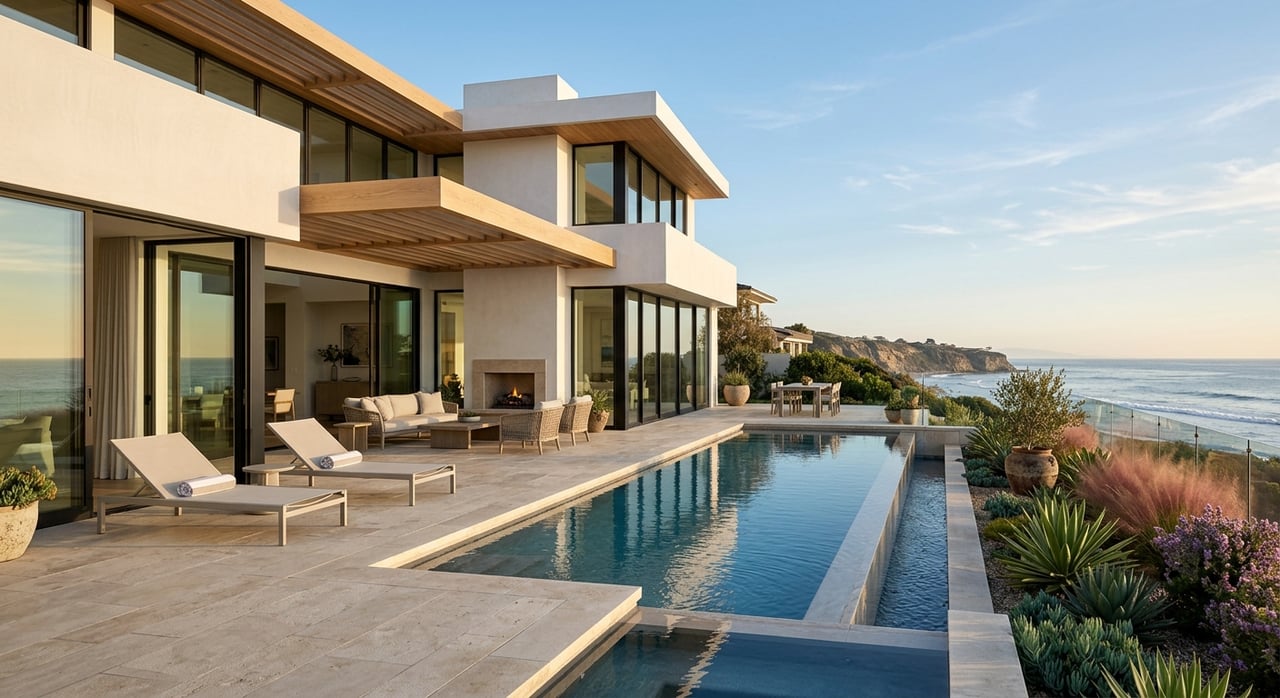
That pattern fits Del Mar especially well. Here, being close to the shoreline is not a generic lifestyle feature. It is a limited asset in a small city where relatively few homes can offer direct coastal orientation, quick beach access, or broad visual connection to the ocean.
This is why proximity alone can move value in a meaningful way. A home that places you closer to the sand, the bluff edge, or a visible ocean backdrop may command more attention than a larger home farther inland.
View Quality Matters More Than “Ocean View”
Not every ocean-view home deserves the same premium. In Del Mar, the city’s planning framework specifically protects public views to the ocean and instructs design review to consider scenic view impacts, which reinforces how important views are in this market.
For valuation, the key issue is view quality. Broad, open, and more permanent views generally carry more weight than narrow, partial, or easily obstructed views.
If you are comparing properties, ask practical questions about the view itself:
- How wide is the view corridor?
- Is the view from main living spaces or only one room?
- Does the view feel usable in daily life?
- Is it likely to remain similar over time under current surroundings and city rules?
A clean panoramic outlook from primary indoor and outdoor spaces usually contributes more than a peek of blue from an upstairs corner. In Del Mar, buyers often pay for the experience of the view, not just the label.
Micro-Location Changes the Value Equation
Within Del Mar, location is not one-size-fits-all. Village homes, bluff properties, hillside sites, and corridor lots can trade at very different levels because they offer different combinations of walkability, view access, development constraints, and site usability.
Village Homes Have a Distinct Appeal
The Village is planned as a pedestrian-oriented, low-scale district. Local planning documents emphasize preserving ocean views, maintaining public realm quality, and requiring design compatibility through rules like stepbacks, setbacks, and view corridors.
For buyers, that can translate into strong demand for homes that combine coastal proximity with a more connected, walkable setting. For sellers, it means a Village location may carry value beyond the house itself, especially when a property fits the scale and rhythm of the surrounding area.
Bluff and Hillside Homes Carry Tradeoffs
Bluff and hillside locations can offer dramatic outlooks and a strong sense of coastal position. At the same time, Del Mar’s Safety Element identifies sandstone bluffs and steep slopes as areas subject to wave action, erosion, and potential slope failure.
The city regulates these sites through overlay zones that can limit encroachment, require hazard mitigation, and in the coastal bluff zone require disclosure of projected hazards in real estate transactions. So while bluff frontage may create a premium, it does not automatically mean a property is worth more than every alternative.
A buyer may place higher value on a home with slightly less drama but easier site use, fewer constraints, and a simpler path for future improvements. In Del Mar, luxury pricing often reflects this balance.
Similar Homes Can Sell Very Differently
Two homes with comparable size and finish level may not trade alike if their lots function differently. One may benefit from a better-protected view corridor, stronger privacy, or more favorable relationship to the street and neighboring homes.
The other may face more entitlement friction, more site limitations, or a less compelling orientation. That is why local, lot-level analysis matters so much in 92014.
Site and View Usually Outweigh Interior Size
In many markets, added square footage can be a major driver of luxury pricing. In Del Mar, site and view often come first.
That does not mean interior space is irrelevant. It means buyers in this market often place a premium on where the home sits, how it captures light and scenery, and how well the layout connects to the setting.
A well-positioned home with a strong indoor-outdoor relationship may outperform a larger home on a less compelling lot. If you are preparing to sell, this is an important mindset shift because maximizing value starts with highlighting the site advantages clearly.
Architecture and Design Still Matter
Del Mar does not require one preferred architectural style. Instead, the city emphasizes quality architecture, site-specific design, articulated wall and roof planes, appropriate materials, and compatibility with the parcel and surrounding context.
The city’s review process also considers scenic views and privacy impacts on nearby homes. That means design value is not just about visual taste. It is also about how well the home responds to its location.
For buyers, this often shows up in homes that feel intentional and coherent. For sellers, it means thoughtful design choices can strengthen perceived quality even when the lot is doing most of the heavy lifting.
Updates Can Create Meaningful Premiums
Location may lead the conversation in Del Mar, but condition still matters. Research included in the report found a renovation premium of about 5 to 7 percent for renovated dwellings and a 9 to 10 percent discount for unmaintained dwellings.
In a luxury coastal market, updates tend to matter most when they help a buyer understand the home quickly. Clean finishes, a polished kitchen, updated baths, and strong indoor-outdoor flow can make the property feel easier, more current, and more aligned with its setting.
The most effective improvements are often the ones that support the lot and lifestyle, not compete with them. In Del Mar, that usually means presenting the view, privacy, and natural light as the stars.
Presentation Influences Buyer Perception
Presentation can shape how buyers experience a property from the first showing. Research cited in the report found that furnishings and wall color can improve perceived livability and overall opinion of a home, even if staging does not always guarantee a higher sale price.
That insight is especially relevant in luxury homes where emotional response matters. A clean, well-composed presentation can help buyers focus on what makes the property special, whether that is the ocean outlook, the lot orientation, or the connection between interior spaces and outdoor areas.
For sellers, this is where a project-managed approach can make a real difference. Coordinating pre-listing improvements, staging, and visual presentation helps the market see the home at its full potential.
What Buyers and Sellers Should Focus On
If you are buying or selling a luxury home in Del Mar, it helps to evaluate value in layers.
Start with the factors that are hardest to replace:
- Lot position
- Ocean proximity
- View width and permanence
- Micro-location within Del Mar
- Site usability and constraints
Then look at the factors you may be able to improve:
- Condition and maintenance
- Kitchen and bath updates
- Indoor-outdoor flow
- Staging and presentation
- Marketing strategy
This framework can keep you from overvaluing cosmetic upgrades on a weak site or undervaluing a well-located home that simply needs better preparation.
Why Local Expertise Matters in Del Mar
Because Del Mar is small, nuanced, and highly site-sensitive, broad averages can miss what truly drives price. A property’s value may turn on view corridor quality, bluff-related constraints, location within the Village, or how a home’s layout captures the ocean from main living spaces.
That is why local analysis matters more than generic luxury metrics. If you want to understand what your property could command, or what a target home is really worth, you need a close read of the lot, the setting, and the way buyers are likely to respond.
At Fine Properties San Diego, we take a concierge, project-managed approach to luxury real estate, including pre-listing preparation, staging coordination, and tailored marketing strategy for coastal homes. If you are thinking about buying or selling in Del Mar, Fine Properties San Diego can help you evaluate where value truly lives and how to position your next move.
FAQs
What drives luxury home values in Del Mar most?
- In Del Mar, luxury values are often driven most by scarcity, lot position, ocean proximity, and view quality rather than interior square footage alone.
Do all Del Mar ocean-view homes get the same premium?
- No. Broader, more usable, and more permanent ocean views generally command stronger premiums than narrow or partial views.
Does a bluff location always increase Del Mar home value?
- No. Bluff locations can offer strong appeal, but hazard exposure, disclosure requirements, and site constraints can affect value.
Do home updates matter in Del Mar luxury sales?
- Yes. Updates and strong condition can create a meaningful pricing difference, especially within the same micro-location, even though site and view often matter more.
Why do similar Del Mar homes sell for different prices?
- Homes that appear similar can vary in price because of differences in lot orientation, privacy, view corridor quality, site usability, and local development constraints.